Main finding
Housing prices responded more strongly to demand in places with tighter regulatory and physical supply constraints.
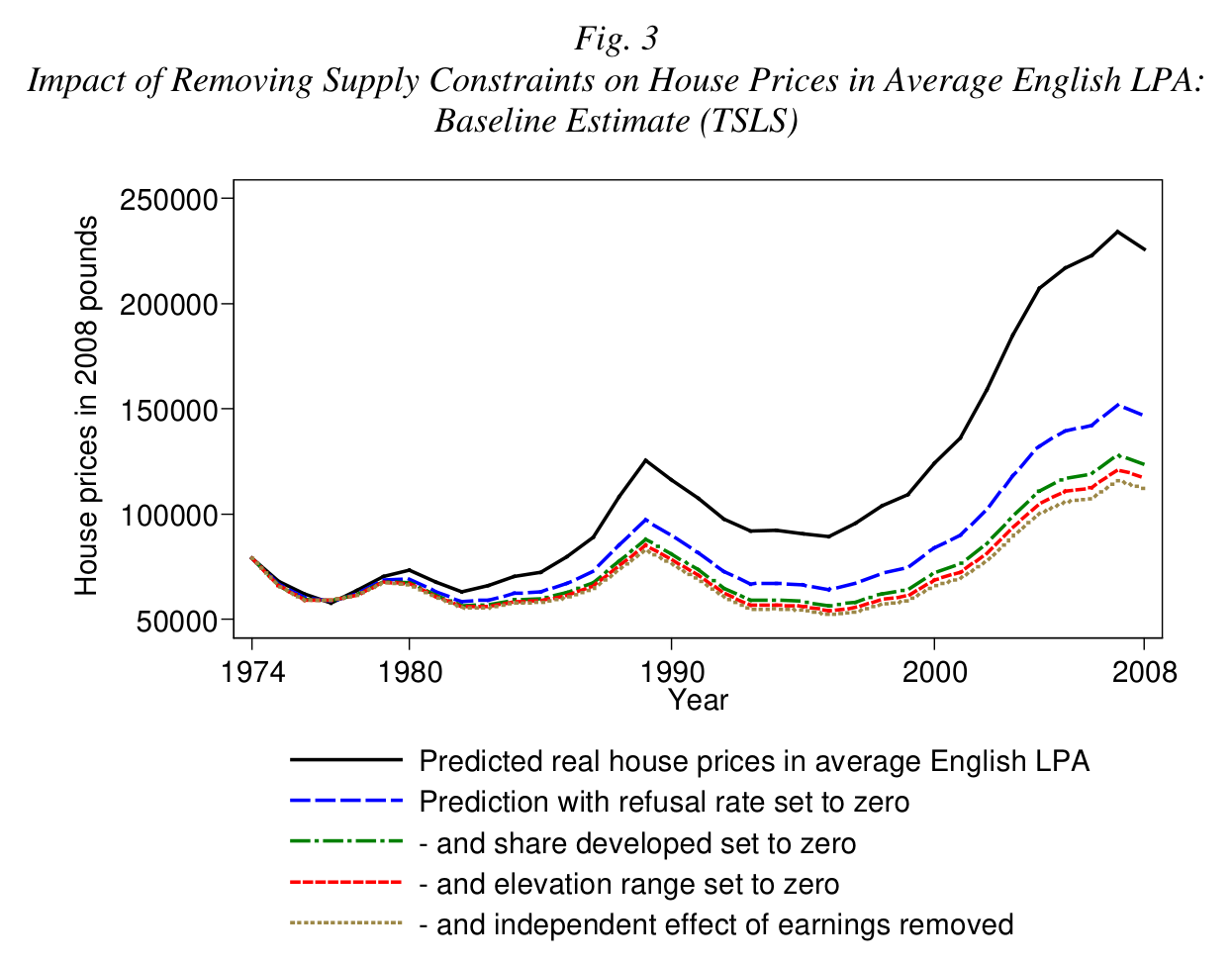
Their counterfactual model estimates 16.3% lower prices in an average travel-to-work area without regulatory constraints
Hilber & Vermeulen
Main finding
Their counterfactual model estimates 16.3% lower prices in an average travel-to-work area without regulatory constraints
Most important limitation
The 16.3% figure is a modeled counterfactual, not the observed effect of one reform, and the setting is England.
From the publication
The modeled price path is lower when regulatory and physical constraints are removed.
How this study is used
Reference
Hilber & Vermeulen (2016). “The Impact of Supply Constraints on House Prices in England.”