06

Faster approvals

Set clear rules—and say yes on time

Debate the rules in public. Then approve homes that follow them without years of hearings, bargaining, appeals, and delay.

In plain English

Debate and adopt the rules in public, then approve individual homes that follow those rules without making every project repeat the political process.

How it works

Remove the barrier. Let homes respond.

01

Set rules democratically

Communities adopt clear standards for safety, form, access, and infrastructure.

02

Approve compliant homes

Projects meeting those standards receive administrative approval on a known timeline.

03

Reduce risk

Less delay and uncertainty makes more projects—and especially smaller projects—financially feasible.

The implementation test

Real reform or paper promise?

By-right approval does not eliminate public standards. It replaces subjective, project-by-project discretion with objective rules adopted ahead of time.

TestStrongWeak or symbolic
Standards

StrongA reasonable applicant can tell whether a project complies.

Weak or symbolicApproval depends on vague compatibility findings.

Time

StrongReviews have published steps and enforceable deadlines.

Weak or symbolicAgencies can restart or extend review indefinitely.

Appeals

StrongAppeals address actual legal errors.

Weak or symbolicOpponents can relitigate a compliant project's merits.

Pair it with

  • Online permit tracking
  • Adequate planning staff
  • Coordinated utility review
  • Fee transparency

Measure whether it works

  • Median approval time
  • Approval-rate variation
  • Carrying costs
  • Share of applications receiving one complete review

In practice

What this reform looks like on the ground.

Austin, TexasMay 20, 2019

Affordability Unlocked

Austin created a voluntary citywide density-bonus program for qualifying affordable-housing developments, with certification connecting eligibility to development review.

Lesson

A legal path matters only if people can use it. Track the whole trip from certification to permit to construction to an occupied home.

Austin Affordability Unlocked ordinance (opens in a new tab)

Why support it?

The evidence behind the solution.

Emerging evidence

Set the rules once. Stop retrying every home.

California's SB 35 gave qualifying projects a faster, more certain path than years of discretionary review. Affordable-housing builders became some of its most visible users.

Keep in mind: The available studies are implementation reports, not causal estimates. Proposed homes may not be completed, projects self-select into the program, and local economics still determine whether a legal path produces housing.
Strong evidence

A city cannot build homes it has made illegal.

Legalize real projects across enough land and builders respond. Auckland did this at city scale and saw a large permitting boom; narrower reforms have usually delivered less.

Keep in mind: Permission is necessary but not sufficient. Financing, land, construction costs, approval time, and demand determine whether newly legal homes are actually built.
Strong evidence

Legal on paper is not the same as buildable in practice.

A reform can promise density and still bury it under tiny maps, parking ratios, setbacks, fees, hearings, and delay. Good reform makes ordinary projects legal, feasible, and predictable.

Keep in mind: Chicago's narrow reform produced no detectable building increase in its early years. That helps show why scale, feasibility, and follow-through matter.
Established evidence

Scarcity turns neighbors into bidders.

When more households want in than there are homes available, the highest bidders win. Everyone else pays more, accepts less, moves farther away, doubles up, or leaves.

Keep in mind: Construction costs, incomes, interest rates, amenities, and migration matter too. Housing supply is not the only force—it is the part local policy can directly obstruct or enable.
Figure from the paper

Figure 2 · Living space after upzoning

The strongest post-reform increases appear after roughly five years, especially for large upzonings.
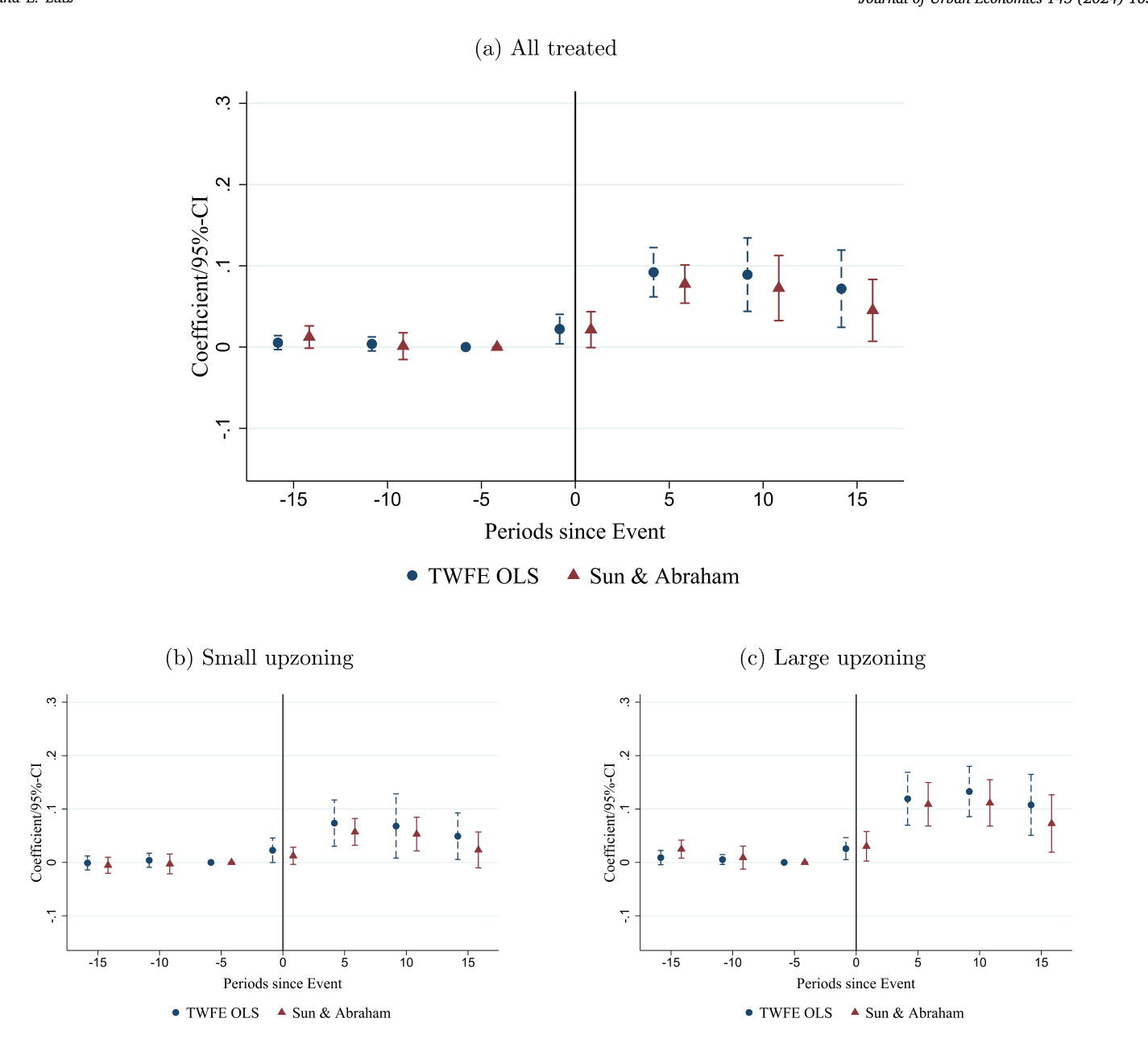
Published three-panel event study comparing all treated, small-upzoning, and large-upzoning effects on living space with two estimators and confidence intervals.

Source: Büchler & Lutz (2024), Figure 2; PDF p. 8.

Read carefully: The outcome is living space, and local quality-adjusted rent differences were not statistically clear.

Figure from the paper

Figure 6 · Estimated treatment effects on dwelling permits

The estimated effects become positive after the reform for both attached and detached homes.
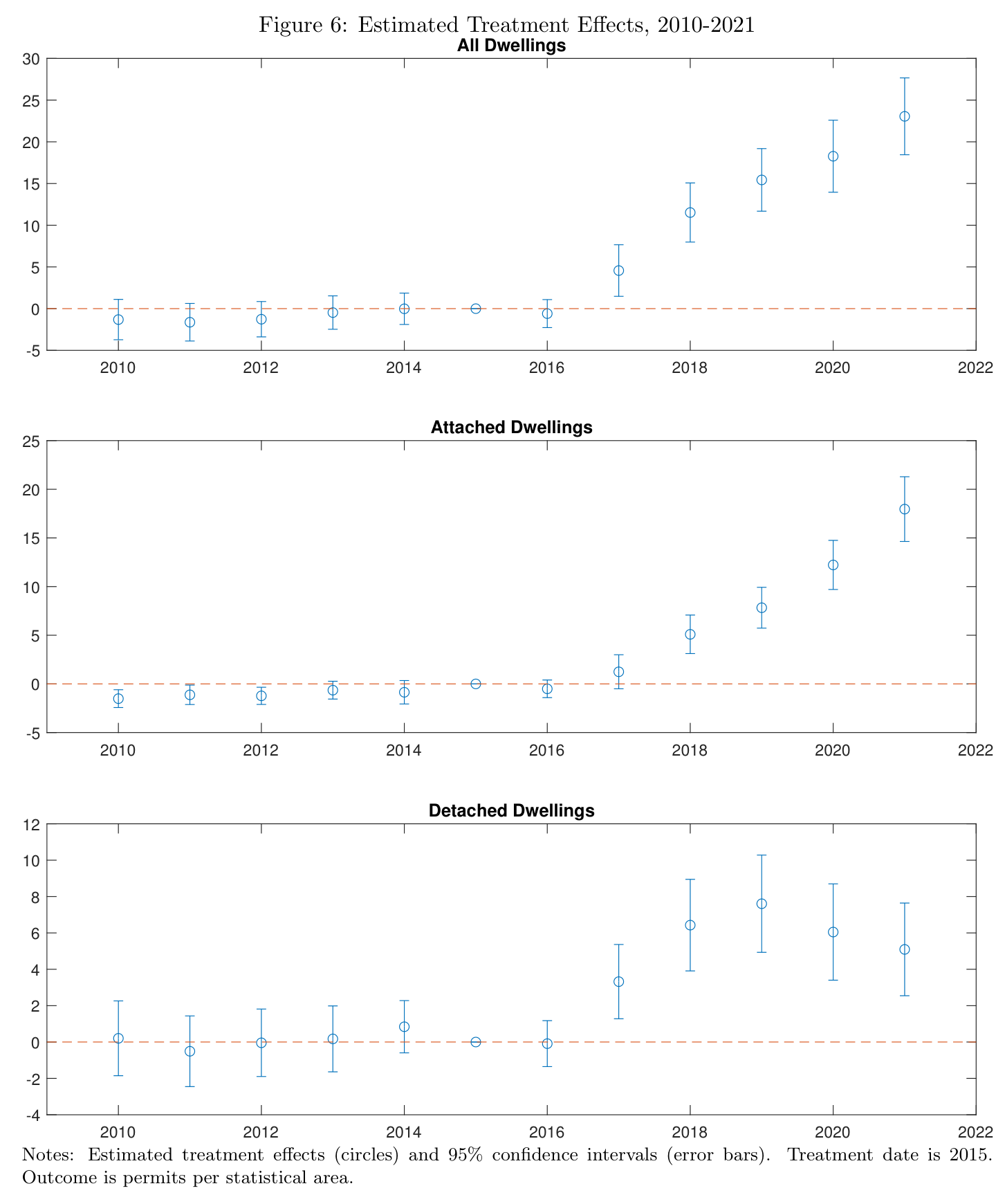
Published three-panel event study showing estimated treatment effects on all, attached, and detached dwelling permits before and after Auckland's upzoning.

Source: Greenaway-McGrevy & Phillips (2023), Figure 6; PDF p. 34.

Read carefully: The outcome is permits per statistical area, not completed homes; the control comparison relies on non-upzoned areas.

Keep exploring