Peer reviewed2023Auckland, New Zealand

The Impact of Upzoning on Housing Construction in Auckland

Greenaway-McGrevy & Phillips

Main finding

A broad reform covering roughly three quarters of residential land produced a large increase in permitted homes relative to non-upzoned areas.

21,808 additional permitted homes over five years

Most important limitation

Permits are not the same as completed or net new occupied homes.

From the publication

Inspect the authors' figure directly

Figure from the paper

Figure 6 · Estimated treatment effects on dwelling permits

The estimated effects become positive after the reform for both attached and detached homes.
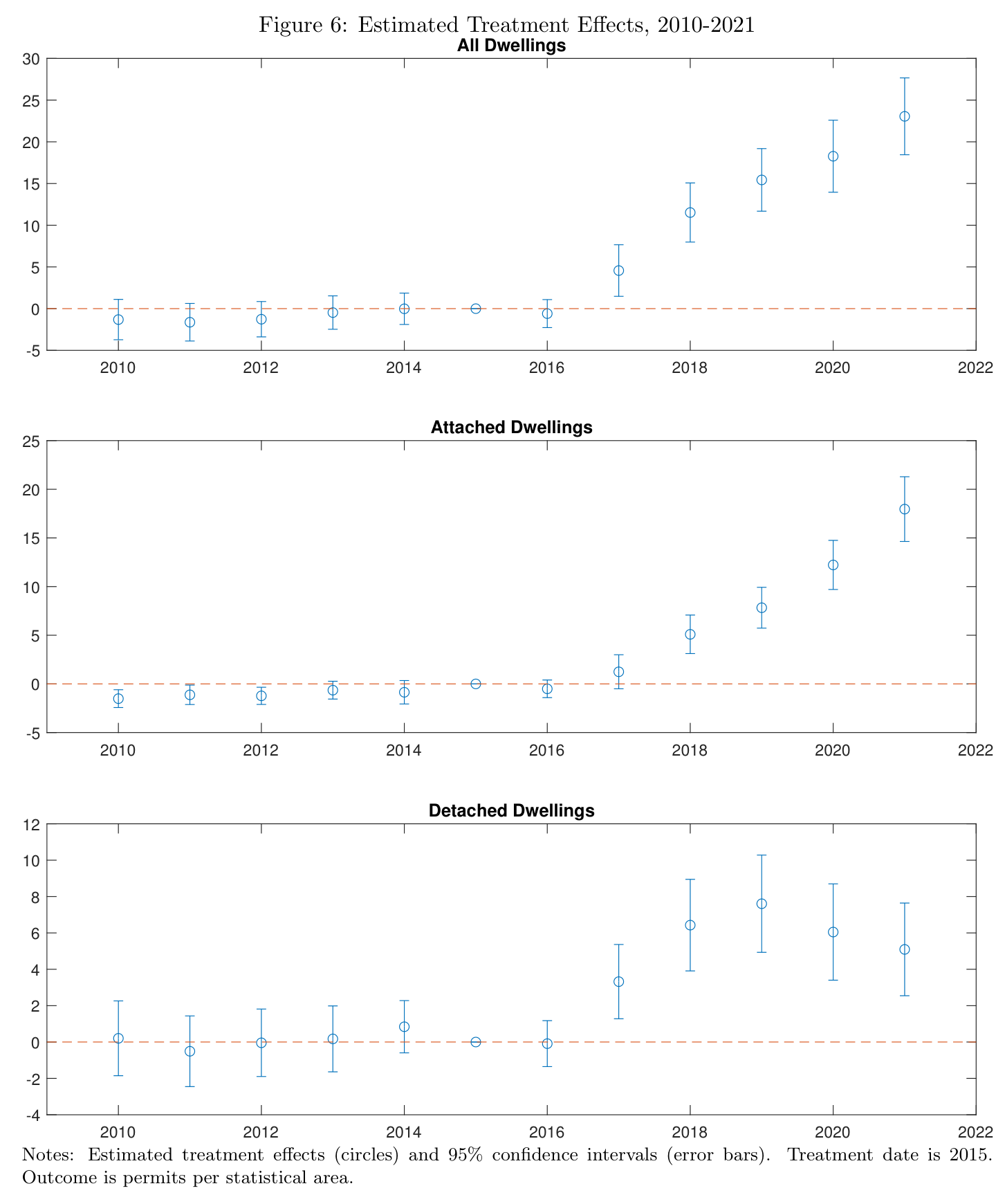
Published three-panel event study showing estimated treatment effects on all, attached, and detached dwelling permits before and after Auckland's upzoning.

Source: Greenaway-McGrevy & Phillips (2023), Figure 6; PDF p. 34.

Read carefully: The outcome is permits per statistical area, not completed homes; the control comparison relies on non-upzoned areas.

How this study is used

Claims this evidence supports

Strong evidenceA city cannot build homes it has made illegal.See the full evidence stack →Strong evidenceLegal on paper is not the same as buildable in practice.See the full evidence stack →

Reference

Greenaway-McGrevy & Phillips (2023). “The Impact of Upzoning on Housing Construction in Auckland.”

Open publisher or paper (opens in a new tab)