Peer reviewed2023Eight U.S. metropolitan regions

Land-Use Reforms and Housing Costs

Stacy et al.

Main finding

Loosening reforms were followed by modest average supply gains, while tightening reforms reduced middle-income-affordable units and raised rents.

Loosening was associated with 0.8% more housing after 3–9 years

Most important limitation

Reforms are heterogeneous and the cross-city design remains observational.

From the publication

Inspect the authors' figure directly

Figure from the paper

Figure 2 · Average number of addresses before and after reform

The two groups track similarly before reform and separate gradually afterward.
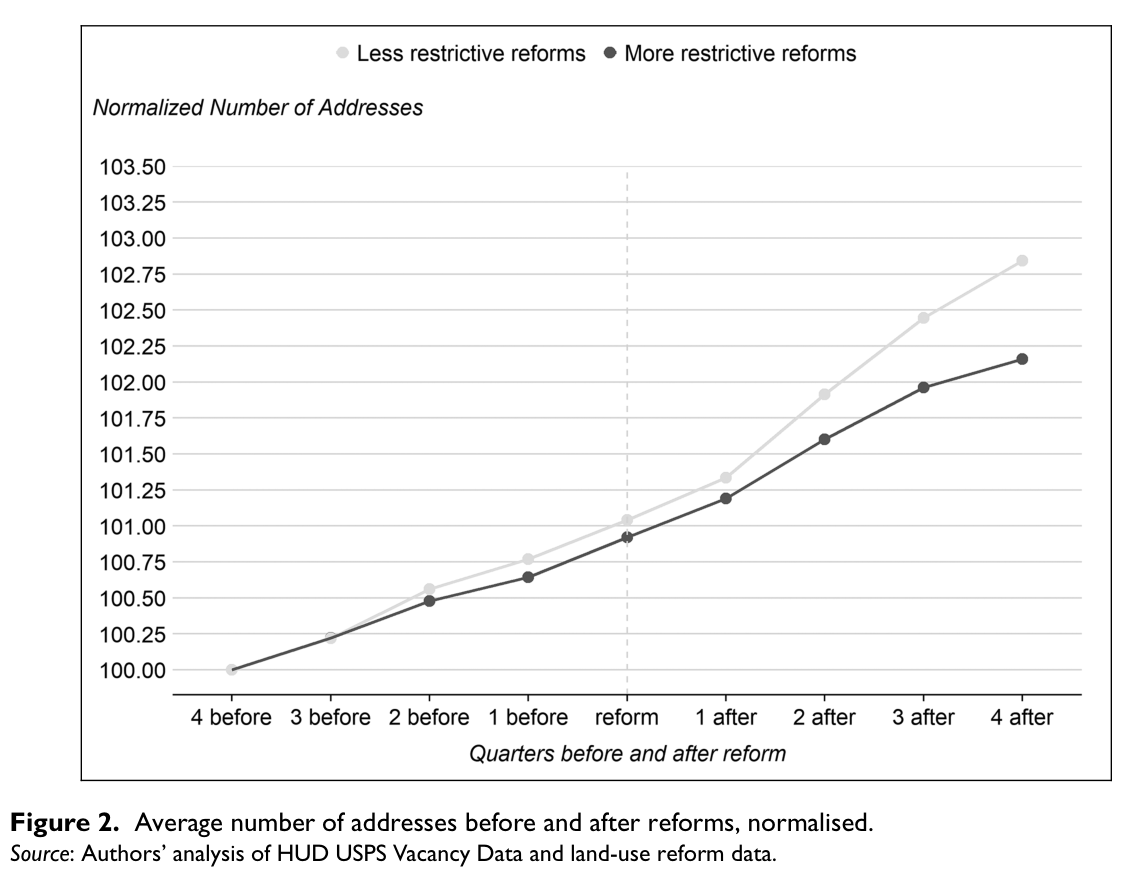
Published line chart comparing normalized address growth before and after less restrictive and more restrictive land-use reforms.

Source: Stacy et al. (2023), Figure 2; PDF p. 11.

Read carefully: The reforms differ across cities, and the observational design cannot eliminate every reason places reform when they do.

How this study is used

Claims this evidence supports

Established evidenceScarcity turns neighbors into bidders.See the full evidence stack →Strong evidenceA city cannot build homes it has made illegal.See the full evidence stack →Strong evidenceLegal on paper is not the same as buildable in practice.See the full evidence stack →

Reference

Stacy et al. (2023). “Land-Use Reforms and Housing Costs.”

Open publisher or paper (opens in a new tab)